
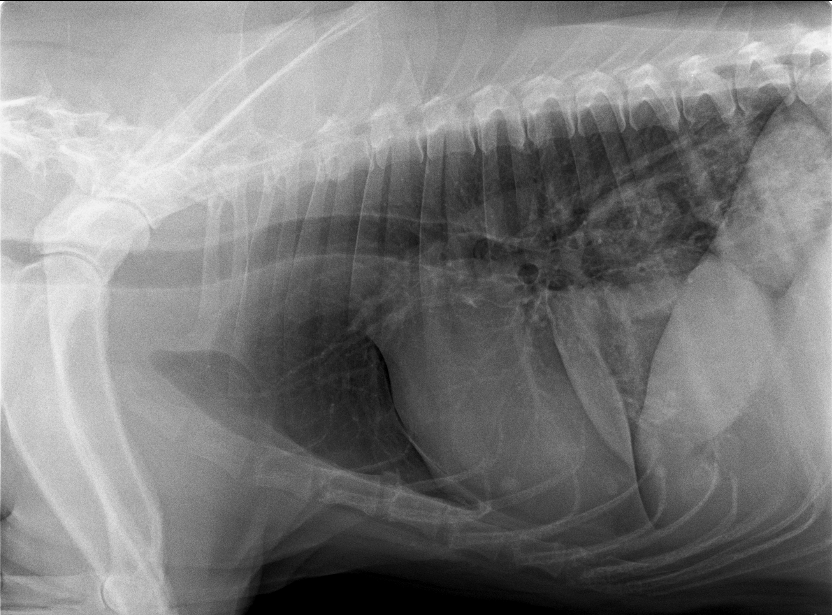
- Canine
- German Shepherd
- female
- 10 years old
Symptoms:
- hyporexic
- apathic
- anxious
- swelling of all four limbs
What is the explanation for the swelling of the limbs?
Patient
- Canine
- German Shepherd
- Female
- 10 years old
History
- Hyporexic
- Apathic
- Anxious
- Swelling of all four limbs
- Afebrile
Clinical examination was unremarkable.
For further clarification, thoracic and abdominal radiographs in 3 views were taken(right and left lateral, ventrodorsal).
Findings
Chest:
- There are multiple well-marginated soft-tissue opacity masses in the lungs. Numerous nodules of variable size are visible in the lungs ventro-caudally.
- The heart and lung vessels are unremarkable.
- The trachea, mediastinum, and pleural space are unremarkable.
- Mild degenerative osteoproliferative changes on the ventral surface of thoracic vertebrae and sternum. Abdomen:
- Serosal detail is good. The liver and spleen have normal size, shape, opacity, and localisation. The stomach is mildly gas-dilated, in a normal position and shape. The small and large intestines are unremarkable. Kidneys have a normal size, shape, opacity and position. Urinary bladder mildly dilated, normal opacity, shape and position.
- Visible long bones
- Matured continuous smooth periosteal reaction on both humeral and femoral diaphysis. No osteolysis is visible.
Diagnosis
- Masses in the lungs are most likely neoplastic (primary lung neoplasia with intrapulmonary metastases). Other possible causes are granulomas and, less likely, abscesses.
- The periosteal reaction represents hypertrophic osteopathy.
Outcome
- No further diagnostics were performed, and the patient was lost to follow-up after the imaging studies were completed.
Discussion
- Hypertrophic osteopathy has many synonyms, including hypertrophic pulmonary osteopathy, Marie’s disease, paraneoplastic osteopathy, acropachy, and acromegalic osteopathy. In humans, it is commonly referred to as osteoarthropathy.
- This syndrome is connected to various intrathoracic pathologies (neoplastic and inflammatory too). However, intra-abdominal pathologies can also cause it.
- The exact reason is not well understood, and numerous theories have been proposed to explain it. Comments regarding the pathophysiology can be found in the cited literature.
- The very first clinical sign is limb swelling. Mostly only the distal part, but general swelling of all four limbs can occur. Limping, hyporhexia, apathy, and fever are present, too. The attached paper also describes ocular discharge and episcleral injection.
- Typical radiographic signs are continuous smooth periosteal reaction on phalanges, metacarpal or metatarsal bones. The periosteal proliferation can spread to more proximal long bones (as in this case). The joints are not affected. Variable soft-tissue swelling can accompany these changes.
Further reading
- Withers, S. S., Johnson, E. G., N Culp, W. T., Skorupski, K. A., & Rebhun, R. B. (2013). Paraneoplastic hypertrophic osteopathy in 30 dogs. Veterinary and Comparative Oncology, 13(3), 157.
- Randall, V. D., Souza, C., Vanderhart, D., & Boston, S. (2015). Hypertrophic osteopathy associated with hepatocellular carcinoma in a dog. The Canadian Veterinary Journal, 56(7), 741.
- Khatat, S. E., Vallefuoco, R., Mrini, M. E., Canonne-Guibert, M., & Rosenberg, D. (2020). Renal adenocarcinoma associated with hypertrophic osteopathy in a cat. Journal of Feline Medicine and Surgery Open Reports.
- Abu-Seida, A., Torad, F., Hassan, E., & Ali, K. (2020). Feline Hypertrophic Osteopathy Associated with Congenital Megaesophagus: Two Case Reports and Literature Review. Journal of the Hellenic Veterinary Medical Society, 71(3), 2413–2418.